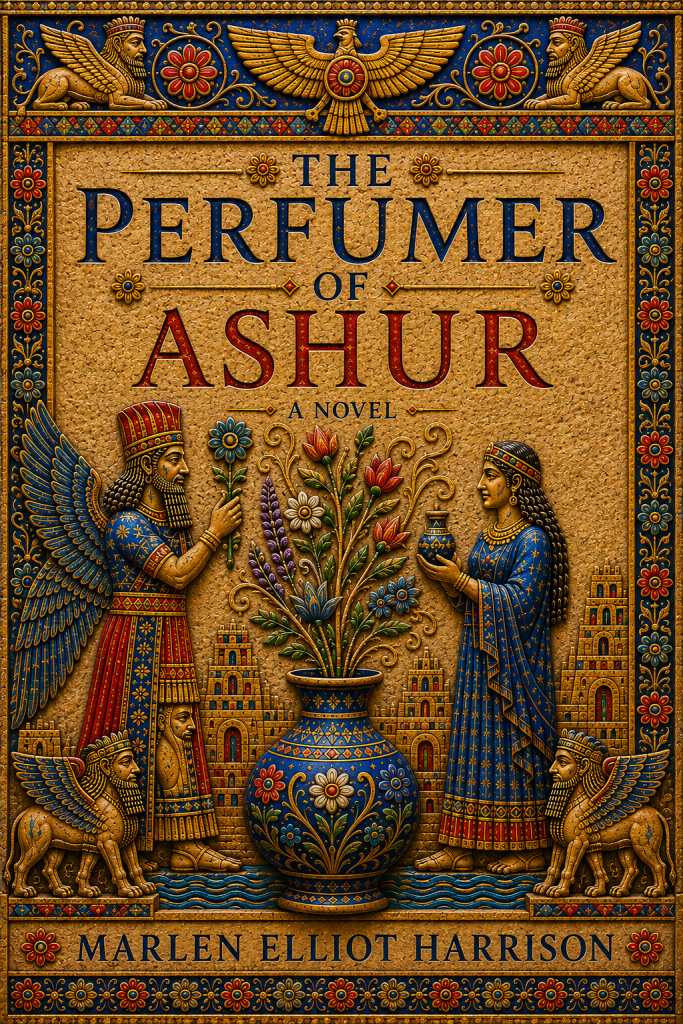
What Is The Perfumer of Ashur?

The Perfumer of Ashur is a historical novel set in the ancient Assyrian city of Aššur during the thirteenth century BCE, at the edge of a world beginning to fracture. At its center is Tapputi, a young woman whose name survives on an ancient cuneiform tablet as a maker of perfumes and aromatic oils. History tells us tantalizingly little about her. The novel imagines the life that might have existed behind that name: the girl before the tablet, the losses that shaped her, and the extraordinary path that carried her from obscurity into the world of temples, palaces, and kings.
Tapputi’s gift is scent. She understands plants, oils, smoke, resins, and flowers not simply as ingredients, but as a language. Yet in a society governed by rank, gender, religion, and law, talent offers little protection. After an act of violence changes her family forever, Tapputi must navigate grief, friendship, desire, rivalry, and the dangerous institutions of Assyrian power while fighting for the right to practice the craft that increasingly defines her.

Around her, the great Late Bronze Age world is growing unstable. Trade routes falter, precious ingredients become scarce, and the structures that once seemed permanent begin to strain. Against that backdrop, perfume becomes more than luxury. It is medicine, ritual, memory, technology, status, and a means of speaking to the gods. Tapputi’s growing mastery of it draws the attention of people far more powerful than she is and eventually places her closer to the center of Assyrian power than she ever intended to be.
At heart, The Perfumer of Ashur asks a simple question: How does an ordinary person become someone history remembers? It is the imagined story behind one of the ancient world’s most intriguing names, a woman remembered not as a queen or goddess, but for what she knew how to make. Through Tapputi, the novel explores grief and ambition, friendship and love, knowledge and power, and the human desire to create something that survives us. Three thousand years later, her name still carries the faintest trace of perfume.
With a nod to blockbuster, scent-centered novels such as Suskind’s Perfume, author Marlen Elliot Harrison celebrates the current genre of reimagining ancient historical characters with a feminist perspective. The Perfumer of Ashur, a work of historical fiction, explores both the imagined life of Tappūtī-bēlat-ekalle – one of the world’s earliest-documented chemists and perfumers – and a lost culture ruled by fragrance-loving gods, demons, and warrior-kings.
Tentative publication date: Autumn, 2028